WorkBuddy Review 2026: I Tested Tencent's AI Office Agent for Two Weeks
WorkBuddy Review 2026: I Tested Tencent’s AI Office Agent for Two Weeks
Five real workloads, two weeks of testing. Where it genuinely beats a chat AI — and where it doesn’t.
Most AI tools are still fundamentally a text box.
You ask, it answers, and then the actual work begins — copying the output into a document, reformatting it, saving the file, pulling data from three other apps. The AI wrote the paragraph. You did everything else.
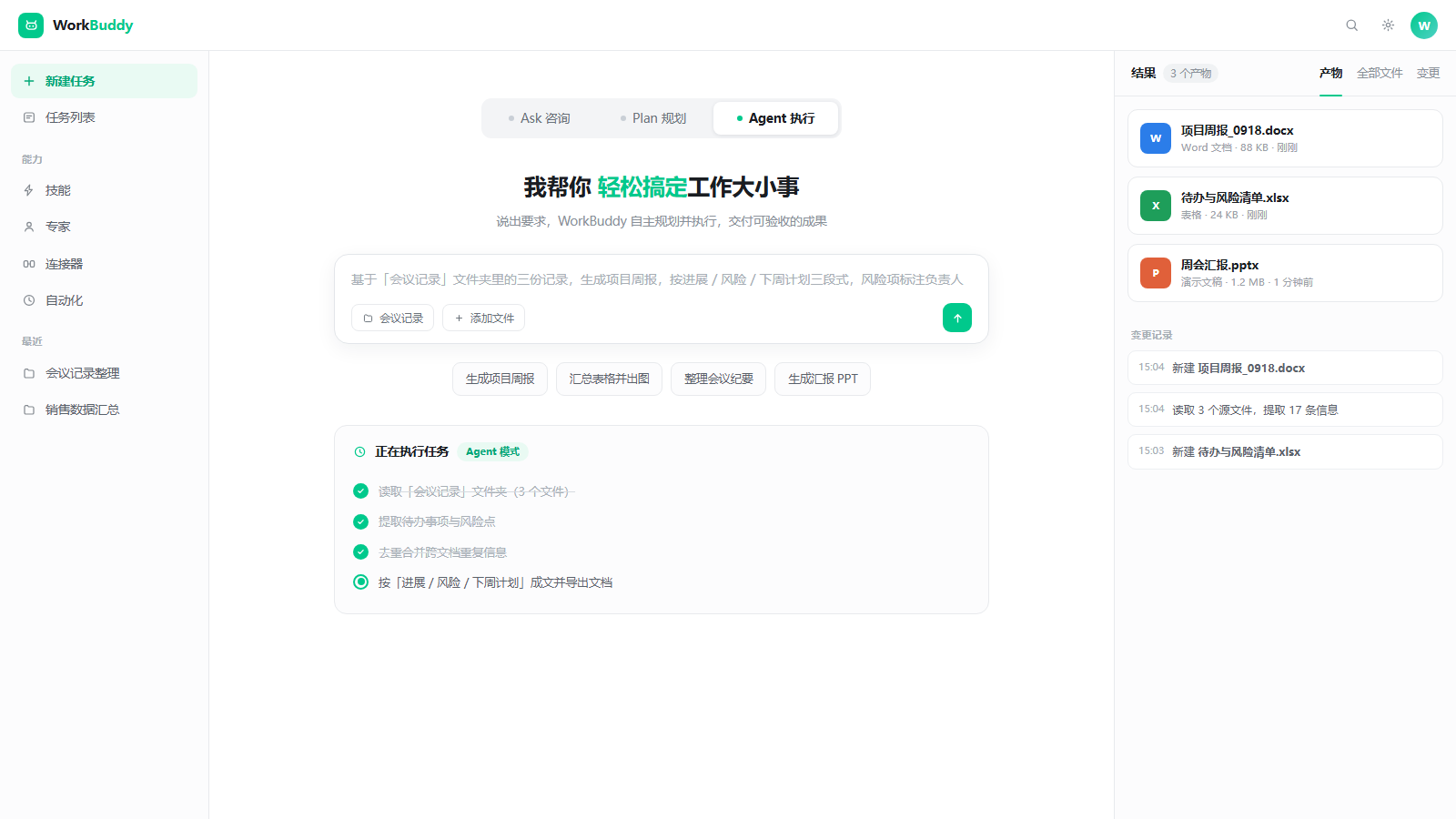
WorkBuddy, built by Tencent, is an attempt to close that gap. The pitch is blunt: state the task, it plans, executes, and delivers a finished result. It runs as a desktop workspace, not a browser tab, and that’s not a cosmetic choice — it’s the whole point.
I spent two weeks putting it through five workloads. Here’s what actually held up.
What makes it different from a chat AI
The distinction is easier to see in a table than in prose.
| Traditional AI chat | WorkBuddy | |
|---|---|---|
| Interaction | Back-and-forth conversation | One-line task brief |
| Output | Text you have to act on | A deliverable file |
| File access | Manual copy-paste | Reads and writes local files |
| Task scope | Mostly single-step | Multi-step, self-planned |
| Timing | Reactive only | Can run on a schedule |
Two rows matter most: file access and timing.
A chat AI’s capabilities end at the conversation window. WorkBuddy’s end at — well, the folder you authorize. It opens your files, processes them in bulk, and writes results back. Add scheduled execution on top of that and the category changes entirely. It stops being a tool you consult and starts being a tool that works.
There are three modes: Ask for questions and quick copy, Plan for breaking down multi-step tasks, and Agent for just letting it run. If you want to feel the difference fast, run the same task through all three — that tells you more than any spec sheet.
Workload 1: Weekly reports and project docs
This is the least glamorous and highest-return use case, because the pain isn’t writing — it’s moving.
I used to keep four windows open to turn three scattered meeting notes into one project report: one AI tab for rewriting, one spreadsheet for action items, one editor for formatting, one for cross-referencing commits. Hundreds of copy-paste operations.
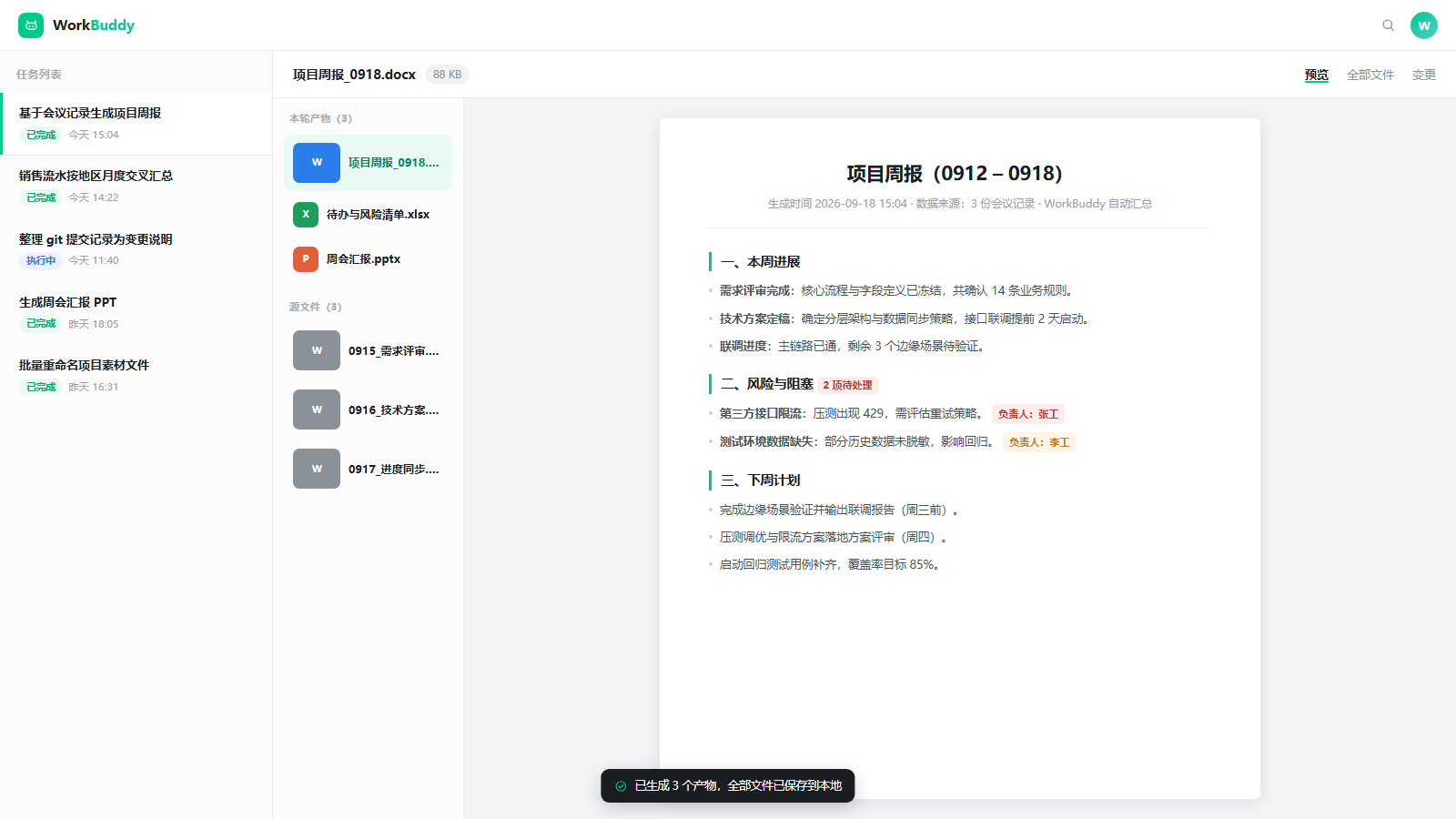
With WorkBuddy I pointed it at a folder and said: build a project report from these three meeting notes, structured as progress / risks / next-week plan, and tag risks with an owner.
It decomposed that itself — read the documents, extract, deduplicate, merge, structure, write the file — and I didn’t touch it mid-run. The output was already formatted. No second pass.
Workload 2: Spreadsheets, where “compute” beats “guess”
This is the sharpest difference I found, and it’s a technical one.
My old workflow with a chat AI: paste in a CSV, ask for a breakdown, get numbers back, retype them into the sheet. Beyond a few dozen rows it starts drifting, because the model is estimating, not executing.
WorkBuddy reads the file locally, filters and aggregates, generates charts, and writes a new file. That’s not a marginal improvement — it’s a different reliability class.
One is a language model doing arithmetic in its head. The other is running actual code.
I tested it on ~200 rows of sales records, asking for a cross-tab by region and month plus a trend chart. It delivered a file I could hand to a stakeholder without touching it.
If you write code for a living, this should feel familiar: the value of an agent isn’t fluency, it’s whether it can genuinely invoke tools. That’s the same shift behind the agent-harness research we covered in the AI coding tools comparison.
Workload 3: Cross-app data — stop being a human API
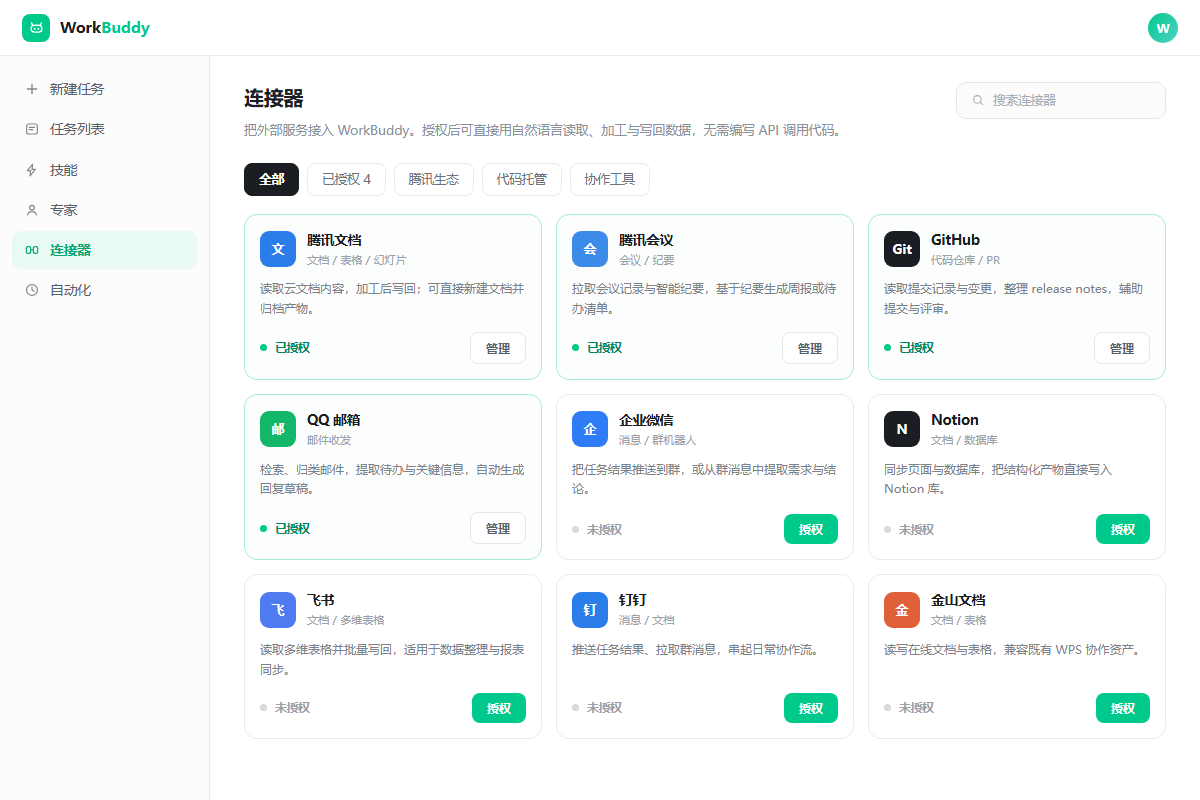
The underrated feature. WorkBuddy ships Connectors, built on MCP (Model Context Protocol). They wire external services into the workspace — Tencent Docs, QQ Mail, Tencent Meeting, WeCom, GitHub, Notion, Feishu, DingTalk, Kingsoft Docs.
Once authorized, the asks get direct:
- “Pull last week’s meeting minutes and draft a project report from them."
- "Analyze this repo’s recent commits and write a changelog."
- "Save this output as a doc in Tencent Docs.”
No code, no API keys to wire up. Connectors page → find the service → authorize → trust.
Before this, my workflow was: export from system A, paste into system B, fix the formatting by hand. I was the integration layer. That’s the part that disappears.
Workload 4: Skills — where compounding starts
The first three workloads are firefighting. The real time savings come from freezing recurring processes.
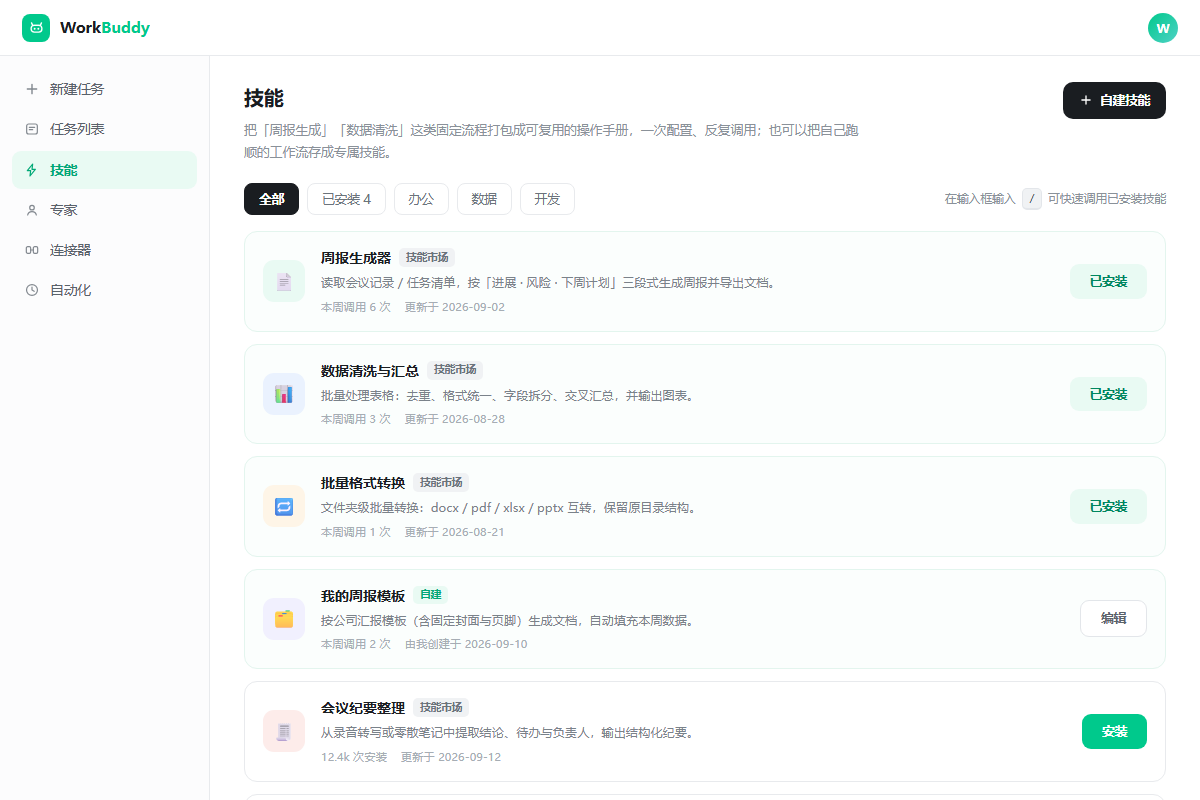
Skills package a fixed workflow into a reusable playbook — weekly reports, data cleaning, format conversion. Type / to invoke one, or ask it to find and install a skill for you. You can also build your own by saving a workflow that already works.
For anyone running recurring reports or batch file processing, this is the step that turns “saved time once” into “saves time every week.”
Workload 5: Scheduled tasks and domain experts
WorkBuddy supports automations — recurring or one-off, running on their own. A data rollup at 9am, a report draft every Friday afternoon.
The semantic difference matters. “Remind me to write the weekly report” gets you a notification; the work is still yours. “Generate the weekly report draft every Friday at 3pm” means the work is already done.
There’s also Experts: 100+ vertical specialists covering development, data, design, ops, finance, and legal. It layers domain framing onto a task so terminology lands correctly. Complex jobs can spin up an expert team that works in parallel.
Where it doesn’t fit
An honest review needs this section.
Don’t bother if your tasks aren’t recurring or complex. For a one-off paragraph or a quick definition, a normal chat AI is fine. This is overkill.
Be deliberate about permissions. Local file access and external system connections are exactly why it’s powerful, and exactly why you should decide your data boundaries before you start, not after.
Vague briefs get bad results. Its multi-tool orchestration is declarative — you describe the goal, it plans the path. That makes prompt clarity the limiting factor on quality. Same discipline as writing a good prompt, and same penalty for skipping it.
Verdict
WorkBuddy addresses a sharper question than “is the AI smart enough”: after the AI answers, who does the rest of the work?
The score
Chat AI: hands you text → you format it, save it, move it between systems.
WorkBuddy: takes a goal → reads and writes files, calls tools, delivers something you can sign off on.
- Buy it if you repeat the same document, data or reporting work every week.
- Skip it if your AI use is occasional one-off questions.
| Workload | Time saved | Recommendation |
|---|---|---|
| Reports / project docs | High | Strong yes |
| Spreadsheets and charts | High | Strong yes |
| Cross-app data pulls | Very high | Strong yes |
| Scheduled tasks | Medium-high | Yes |
| One-off Q&A | Low | Skip it |
If you try it, start with exactly one task you repeat every week. Get that working before expanding permissions.
Want to run the same five workloads yourself?
Tencent’s invite program currently adds 2,000 bonus credits on sign-up — enough to test all five workloads above without paying.
Get WorkBuddy with 2,000 credits →Desktop app · Windows & macOS · No credit card
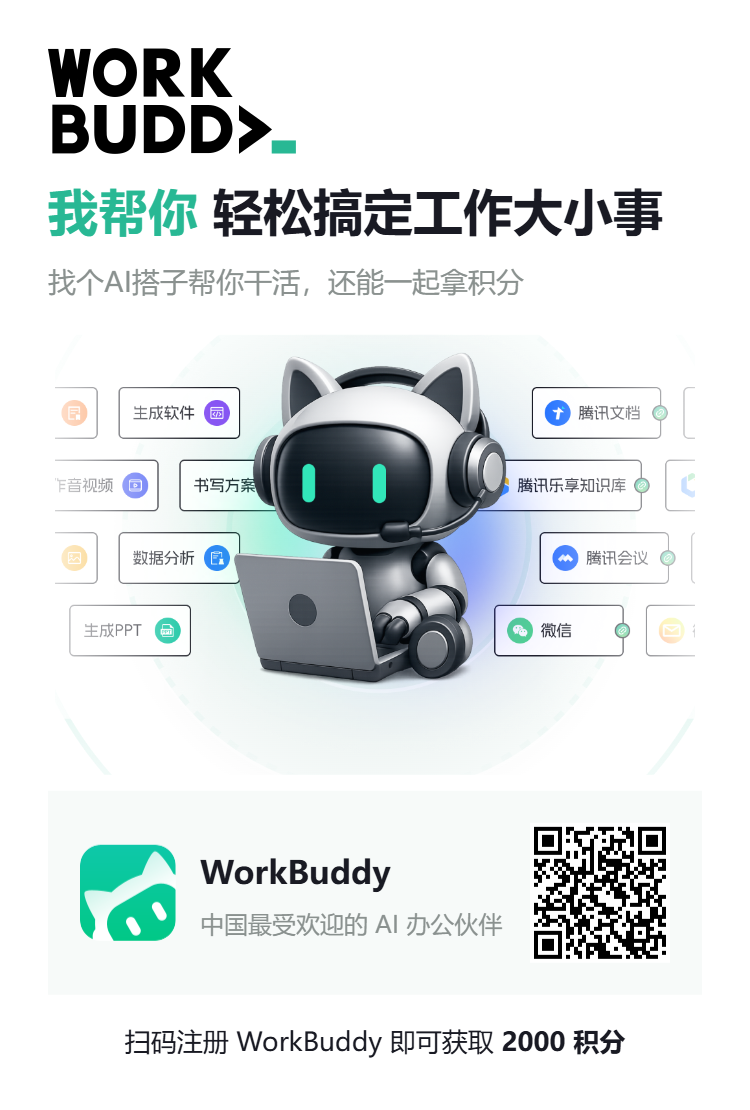
Hands-on testing notes. Screenshots in this article are UI illustrations drawn to the vendor’s published visual style, not official captures. Feature availability subject to the vendor’s latest documentation.